Showing posts with label paulo's book club. Show all posts

Monday, May 09, 2011

Paulo's Book Club: "Go The Fuck To Sleep"

"The eagles who soar through the sky are at rest
and the creatures who crawl, run and creep.
I know you're not thirsty. That's bullshit. Stop lying.
Lie the fuck down, my darling, and sleep."


This book is for every parent who tried to put a child to sleep. And we're not talking about babies, we're talking about walking, talking toddlers, who stall, delay and concoct excuses.


Every night 10 minutes after going to bed Chase comes down and asks if he can get a car to bring upstairs to sleep with him. We usually allow that. The second time he comes out is usually to ask what show we're watching. Sometimes he does that in reverse order and asks us not to pause the show when he comes down to get his car, so he can see the show. If he's really tired that will be it. But on other nights he'll come out three or four more times until we threaten to lock the door.


Oh yeah, that reminds me, "I'm thirsty" is another good one. This book looks hysterical and it's not just an internet thing. You can actually buy it on Amazon (using the link above) and a hard copy will ship in October.

Monday, May 03, 2010

Paulo's Book Club: "Real Men Don't Say Splendid"

"Real Men Don't Say Splendid: A Lexicon of Unmanliness" is a silly little book that literally takes all of 10 minutes to read cover to cover.
But if you love words the way I do, it's a funny 10 minutes.


Simple premise: it lists 99 words real men should never say under any circumstances and it gives sentences for each one.

A large portion of the words are only used by gay men and gossip magazine writers: Canoodling, Preggers, Galpal, Chic, Elegant, Nuptials and the homosexual standard, Fabulous

There's also quite a few words Mrs. Poop uses on a regular basis which is ok because she's a girl: adorable, comfy, cuddle, snuggle, dilly-dally and scoot.
If Chase and I are laying in bed and she wants to get in she might say "you guys look comfy but can you scoot so I can snuggle and cuddle with you."

The word golly might have been added after the author saw me at a goyisha wedding because the accompanying sentence is: Golly, that's a lot of shrimp for one person.

Seinfeld perfectly captured the essence of this book when saying he didn't want to carry the chocolate babka to the party because standing at the door holding a box by a little string is a "tad dainty." Both those words are in the book.

A few other good examples from the book that I absolutely agree no real man should ever use: fancy, heartthrob, mingle (especially as in "I'm single and ready to mingle"), glamorous and hunk.

But a few of the entries I really don't understand their inclusion:
Boobies: Sometimes you have to talk about tits but you can't call them tits, boobs or boobies is the best alternative here.

Giggle: I don't know a good synonym to describe this type of laughter.

Oops: What else are you supposed to say when you make a mistake?

Shimmy: Only acceptable when quoting Major League 2: "Parkman is doing that little shimmy, it makes the women here in Cleveland wanna puke."

Tasty: Once again a manly movie quote "MMMM, this is a tasty burger."

Panties: There is a manly way to say this "She wasn't wearing any panties dawg."

In place of those I word have added: drafty, duvet, draperies and exquisite

Friday, September 25, 2009

Paulo's Book Club: "Fooled by Randomness"

A funny thing about life, two people can look at the same thing, and see it completely differently. And that's why I didn't like "Fooled by Randomness" by Nassem Nicholas Taleb.

The book explores the "Hidden Role of Chance in Life and the Markets," something I often think about.

But here's the difference, I look at the strange things that happen and see the Universe, Taleb sees randomness.


The book is interesting because Taleb provides a great many thought experiments to prove his points but his thinking a little rigid, and he overuses ancient philosophers.

One of Taleb's main point is about the "black swan." He theorizes, correctly, that seeing a million white swans, doesn't prove that all swans are white, but seeing only one black swan, disproves that theory.

The Black Swan (another of Taleb's books) is the name for an unexpected event. He used the black swan theory to say that basically none of the traders on Wall Street have any idea what they are doing. They just do what everyone else is doing, and through pure luck, avoid the black swan. But when the black swan comes, the explode, and explode spectactularly, a theory that seems to fit and even the foretell the current economic crisis.

Although I disagree with Taleb's cynicism, many of you who think my Universe talk is crazy might enjoy his take. Hell, he may even be right. But my way is much more fun.

Friday, July 24, 2009

Paulo's Book Club: "Entwined Lives"

"Consider the case of the so-called Jim Twins, which appears in the book Entwined Lives by Nancy L. Segal, director of the Twin Studies Center at Cal State-Fullerton. Split up at four weeks and then living separately for 39 years without knowledge of one another, the men, both named Jim, married women named Linda, divorced them and then married women named Betty. They gave their sons the same name. The twins smoked the same brand of cigarettes, drank the same brand of beer. They vacationed at the same Florida beach and drove light-blue Chevrolets."


That's the paragraph (from a Sports Illustrated article on the Sedin Twins), that made me interested in reading "Entwined Lives" by Nancy Segal.
If that paragraph doesn't intrigue you then you are either dead or not very smart.
And the book was well worth it. Beyond just the Jim Twins there was the fascinating story of identical triplets, reared apart, who were reunited later in life and eventually went to work at the Concierge's favorite restaurant, Sammy's Roumanian, before starting their own, Triplets' Roumanian.
The chapter on twins reared apart was probably the most intellectually fascinating because that's Segal's area of expertise.
For instance, identical twins reared apart are more alike than even fraternal twins who were raised together, showing the impact of nature vs. nurture.

And that really is the main theme of the book, by looking at twins, especially identical twins reared apart, we can see how much of behavior, and physical appearance is influenced by genetics, and how much by environment.

The universiality of that theme makes the book a great read for singletons, but the book is a must-read for twins and parents of twins.

I know several families raising or expecting twins and I think they all would benefit from Segal's perspective on how to raise the kids, as it pertains to treating them equally while encouraging and preserving their own identities. Every parent of twins will someday be confronted with the following conundrum: when the kids are old enough to enter school, should they be placed in the same class, or separated? Nancy Segal has an answer.

There is one drawback in this book. Nancy Segal is a doctor, a researcher and an expert who has spent her entire career studying twins. She is not a writer. The book is somewhat hard to read because it is written with a lot of medical jargon. It goes heavy on the numbers and the research, and light on the anecdotes. You can skip some chapters, like the one on twins in the animal kingdom, but I wouldn't suggest that because you can learn great things such as: armadillos have kite-shaped uteruses.

I recommend this book whole-heartedly to twins and singletons alike. It is a must for people with twins and people with curious minds.

Friday, June 26, 2009

Paulo's Book Club: "Blood in the Cage"

"Losing feels like sucking a thousand dicks with your mom watching"

That uncredited quote sums up the passion captured in "Blood in the Cage" by L. Jon Wertheim. The book tells the story of the early days of UFC, using Pat Miletich as its vehicle.


Miletich has a somewhat typical upbringing of an MMA fighter. His father was no good and his poor mother raised five kids. His brothers all went down the wrong path (either ending up dead or in jail) and the only thing that saved Pat was his ability to fight.

Militech was one of the early proprietors of MMA back when the UFC had no rules and lots of opposition from politicians. But then Dana White and the Fertitas came in, and this is where Miletich sort of disappears from the book.

Like those old-time baseball players, he came along too soon, fighting for a couple hundred dollars a show, up to three times a night. Now these guys earn millions for two, maybe three fights a year!

But here's where the book falls short, it follows Miletich right up until his fighting career ends, then picks up the case of the UFC. It never explores Militech's coaching career in as much depth as I would have liked.

And while the story takes UFC from its infancy of eye gouges and head butts until Dana White and the Fertitas take over, it only does a cursory job of following and explaining the sport's explosion.

Essentially it comes down to this. If you like UFC or even have a passing interest in it, you will love this book. If you don't really care, you probably still won't after reading this book.

Friday, June 05, 2009

Paulo's Book Club: "Straw: Finding My Way"

"Straw: Finding My Way" is not a book about baseball. It's a book about Darryl Strawberry's life.
Most of the book covers his long spiral down, but the final few chapters focus on his recovery.

When this book came out some lascivious details of his days with the Mets were released, but if that's why you read this book, then you are going to be disappointed.

Many people get frustrated listening to people who have led troubled lives feeling as if they blame their problems on a troubled past. Strawberry describes his abusive relationship with his father (which came to a head when he pointed a shotgun at his wife and kids) but is careful not to blame that for everything he did.

Eventually things came full circle and Strawberry -- high on drugs -- held his own family at gunpoint. But even that wasn't enough to bring him to his senses.

Two failed marriages, several failed stints in rehab, and one incredibly discarded baseball career weren't enough to make him change his ways. Even a battle with cancer couldn't get Strawberry to stay off drugs.

And that's why so many are skeptical to believe that this is the time he has finally turned his life around. But either way, it's worth reading about.

Friday, May 29, 2009

Paulo's Book Club: "War As They Knew It"

It started with a punch -- and ended with a punch.

"War as They Knew It: Woody Hayes, Bo Schembechler and America in a Time of Unrest." by Michael Rosenberg starts with Woody Hayes assaulting one of his own players, and essentially ends when Hayes assaults an opponent.

While purporting to cover the heated football rivalry between The Ohio State University and the University of MIchigan, the changes in America during the late 60s and early 70s and the teacher-student relationship between Hayes and Bo Schembechler, Hayes is such a powerful figure he steals the show.


Having been born a few months before his last game, I only came to know Hayes as a crazed codger who threw tantrums and acted like a boor (sort of Bobby Knight before Bobby Knight).

But this book reveals a much deeper side to Hayes. Hayes was tough, but he loved his players. And he was far from a meathead laser-focused on football. Hayes was a history buff, with an encylopedic knowledge of war and U.S. Presidents. He was also a huge fan of Ralph Waldo Emerson (my favorite transcendentalist author), owning nearly all of his published works. Rosenberg generously sprinkles the wisdom of Emerson throughout the text.

Hayes's antics are the best part of the book. And that's why at times it seems like a biography of Hayes with some other characters thrown in.

Though a powerful character in his own right. Bo Schembechler takes a backseat to Hayes in this book. In fact, he's the third most interesting aspect of the Michigan story.

Most of the focus in the book goes to Michigan's student body's political activism. Michigan is cast as the progressive school with sit-ins and protests while Ohio State is the old stodgy school wanting to remain in the 40s.

But there's also Athletic Director Don Canham who created the famous Big M logo and ushered in a new era of marketing for college sports.

There's a raft of interesting characters mentioned, Bill Ayers, Bobby Knight, Presidents Nixon and Ford and even Dick Vitale is mentioned.

But there's also the football. Each game in the Ten Year War is described in detail and all the dramatics surrounding football blend prefectly with all the dramatics at these schools and in the country during the time when these two great coaches went head-to-head.

Friday, May 15, 2009

Paulo's Book Club: "The Complete Game"

If you ever wanted to be a Major League Baseball pitcher you should read “The Complete Game” by Ron Darling.

The book goes through a game one inning at a time, plucking one of each inning from Darling’s career – including two games he broadcast but didn’t pitch.
Each inning is selected for its ability to prove a point. His first major league inning perfectly describes his nervousness, while other innings discuss things the lefty-righty specialization in today’s game and one inning even covers Darling get rocked and throwing at a batter. That leads to several pages of discussion on pitching inside and even hitting guys when necessary.

The book doesn’t really explore each inning pitch-by-pitch, which I would have liked but I understand may have bored some. Instead the book explores the mental aspect of the game leading up those these different circumstances. And this is where Darling is refreshingly honest. Not honest in that he provided every detail of life with the mid-80s Mets, but honest in that he shares what he was feeling at the time. He was nervous for his first ever start, pumped for his World Series start after seeing his dad on the field, and he even admitted when he was scared or distracted on the mound.

It’s that honesty – and the cool stories like the one about where he was when Terry Pendleton hit that infamous home run in 1987 – that make this book a must read for any Met fan, or any baseball who wants to get a better understanding of what a major league pitcher goes through.

Friday, May 08, 2009

Paulo's Book Club: "Living On The Black"

"Living on the Black" by John Feinstein is the finest book I have ever read about the art of pitching.


"Living on the Black" chronicles the 2007 season through the eyes of veteran pitchers Tom Glavine and Mike Mussina. While the two separate storylines sometimes make it confusing to remember who you're reading about, Feinstein enlisted two pitchers for his work because in case one got injured, or had an uninteresting season he had the other as insurance.

And that decision worked out fine as Mussina struggled with injury and ineffectiveness, Tom Glavine had a remarkable year, and his chase of his 300th win (the Number that Must Not Be Named) is the book's central theme.

I absolutely love this book and don't want to ruin it (although the ending ruins it for most Mets fans -- an entire chapter on that disastrous final start of the season for Glavine), but here's what you learn about Tom Glavine: every hit he ever gave up was the umpire's fault. He knew that he had to get outside pitches called as strikes so if the umpire didn't give it to him on one pitch, he'd go right back there, and if they umpire didn't see the first call as a mistake, he'd be down in the count 2-0.

Glavine and Mussina proved to be great choices for a book of this nature because they were both honest (they kind of come off as whiners) and intelligent, really giving the reader a feel for what a pitcher goes through as he pitches well, and especially when he pitches poorly.

It's that insight that makes "Living on the Black" a must-read.

Friday, May 01, 2009

Paulo's Book Club: "The Yankee Years"

"The Yankee Years" by Joe Torre and Tom Verducci is a must-read for any Yankees fan. Unfortunately Yankees fans can't read.

For the rest of us who love baseball (even if we hate the Yankees) this is a great book covering two eras in Yankees history, their dominant run of four World Series in five years and their subsequent decline (such as it was with 2 World Series).

Before I talk about the content I think I should first explain that Joe Torre didn't write this book. Tom Verducci wrote this book, and Joe Torre was a major contributor, especially at the end.

In fact, it sort of seems as if Verducci wrote the entire thing, then all of the sudden Torre left the Yankees, and Torre jumped in and co-wrote the final few chapters, so he could give his side of the story on his departure.

The controversy surrounding the book upon its release revealed as much, you know Torre would never compare A-Rod's obsession with Jeter to "Single White Female." That was Verducci's voice, and quite possibly even his own observation.

In fact, the first part of the book is told with as much input from David Cone and bullpen catcher Mike Borzello, as it is with Torre.

That's the part of the book that describes the Yankees dynasty and it's a fascinating case study because of all the great tidbits about the individuals who breezed through that clubhouse.

For instance, I feel vindicated because for years I have been saying Paul O'Neill was a selfish player and no one believed me. This book says it explicitly, going so far as to say Yankees coaches couldn't position O'Neill in the outfield because he was too busy practicing his swing in right field.

Torre's handling of O'Neill, David Wells, then Roger Clemens and Gary Sheffield is what makes this book a great look into the mind and methods of this great manager.

But then it all turns south. Verducci explores the trends in baseball (steroids, "Moneyball") that turned the tables in the Yankees-Red Sox rivalry. And then we come to the beginning of the end for Torre and the Yankees.

Without giving too much away (you already know how it turns out though), the basic point here is that none of this would have happened if George Steinbrenner were still alive. With the Boss reduced to a drooling, shaking, crying shell of his former self, his minions took over and turned against Torre.

From Torre's perspective he was basically forced out, ending an incredibly successful 12 year run with the Yankees.

For its coverage of Torre's ups and downs as Yankees manager this book covers all the bases and I really do consider it a must read for any true baseball fan even if you hate the Yankees.

Sunday, April 26, 2009

Paulo's Book Club: "Pedro, Carlos & Omar"

Reading “Pedro, Carlos and Omar” by Adam Rubin, with the benefit of hindsight actually ruined the book for me. The book was written on the premise that the signing of Pedro Martinez and subsequently Carlos Beltran was going to have a transformative impact on the organization, resulting in several World Series titles.


Reading it now, four painful years later, takes a lot of the excitement out of it.

The book also pushes the premise that Pedro’s impact would be felt beyond his performance on the field. It would be a recruiting tool for other top Latinos (starting with Carlos Beltran) and it would turn the Mets into Los Mets, a marketing juggernaut in the growing Hispanic market.

Four years later I now consider the Pedro Martinez signing one of the worst in Mets history. An injury prone pitcher, past his prime was given four years and $53 million. After a hot start in his first season (12-3) he limped to a record of 20-20 over the rest of his contract and was never there when the Mets needed him.

And his impact as a recruiter is grossly overstated as well. He supposedly was the reason Carlos Beltran signed with the Mets, but the book even says Beltran wanted to take $14 million less ($2m per year) to stay with the Astros, but they wouldn't give him a no-trade clause. And they didn't have Pedro. Beltran also wanted to sign with the Yankees for less money, but they didn't want him (no Pedro there either).

And Carlos Delgado? He turned down the chance to be Pedro's teammate when he was a free agent, and even bristled at the Mets' overuse of the Hispanic thing in his recruitment. He only joined the Mets at gunpoint after the Marlins sucked, then traded him.

The flawed premise of the book notwithstanding, I also dislike the style in which it is written. The book reads too much like a best-of compilation of Rubin's Daily News game recaps.

There are some great anecdotes about the offseason wheeling and dealing, and even some gems from during the season, but mostly it's a rehash of the games, without enough new info to make rehashing them worthwhile.

"Pedro, Carlos and Omar" shows a lot of promise, and starts strong, but is missing that certain something that would take it from good to great. Sort of like the team it describes.

Thursday, February 19, 2009

Paulo's Book Club: "Boys Will be Boys"

"'Charles used to beat off in meetings while talking graphically about players' wives...It got to the point of ejaculation."

And Charles Haley is just one of the interesting character Jeff Pearlman introduces us to in "Boys Will be Boys: The Glory Days and Party Nights of the Dallas Cowboys Dynasty."

Boys Will be Boys by Jeff Pearlman

The book’s central character is Michael Irvin. His arrival coincided with the team’s ascent and his demise mirrored the organization’s fall. Irvin is portrayed as the playground bully. If you didn’t follow him he punched you in the face, but if you stuck with him he’d give you the two hottest groupies in the bar, before choosing the ones he was taking to his room to perform lesbian sex shows. Irvin was the central protagonist, defining the Cowboys with his arrogance and his party hard, play harder ethos. It was Irvin who took over the Cowboys charity basketball team, Irvin who was among those behind the White House and Irvin who fractured the team when he stabbed offensive line Everett McIver in the neck with scissors.

Aside from Irvin, the action in the book revolves around Jerry Jones and his two coaches. Jimmy Johnson is portrayed as a dick who cuts players just to send a message to his team. He treated everyone like shit and wanted all the credit for the team’s success. And that’s what pissed off Jerry Jones who thought anyone could win the Super Bowl with his team, and that’s exactly what Barry Switzer did. But Switzer is portrayed as a bad coach, who delegated everything and never disciplined anyone (with good reason, as you’ll learn) though the lack of discipline is what’s blamed for bringing down the Cowboys dynasty.

Troy Aikman is the golden boy who got pissed when his teammates weren’t working hard enough. Emmitt Smith is a minor player who his teammates hated because he only cared about his stats. Deion Sanders was a lazy hired gun who refused to tackle during practice or study film during meetings. And Alvin Haper was Freaky Harp, banging more groupies than anyone.

But that’s about it as far as lascivious details go. There are no great stories of unusual sex-capades with cadres of groupies. Just mentions that just being a Cowboy was enough to get any of the long-legged, large breasted women in Dallas to want to sleep with you, even if you were a backup safety. And the Cowboys loved their drugs and women just as much as the women loved them.

And eventually it became their downfall.

This book is a definite read for any sports fan who remembers those Cowboy teams (with envy or with fondness) and enjoys getting a real look at athletes (Pearlman pulls no punches, insulting even some of the guys who were his best sources) and the lives they lead off the field.

Friday, February 06, 2009

Paulo's Book Club: "Marley & Me"

"We could have bought a small yacht with what we spent on our dog and all the things he destroyed. Then again, how many yachts wait by the door all day for your return?"

If you can understand that sentiment then you will love this book. If you can't imagine how anyone could love an animal that frequently causes trouble and often causes damage, then you've never loved a dog before. At least not a bad dog.

While the antics of Marley are what makes the book, the relationship between Marley and John and to a lesser extent Jenny, and eventually with their three kids, is what makes this book great.
But what makes this book one of my favorites ever, is the parallels between my life and the life of the author.
He's got Marley, I've got Diesel.
Marley's a lab, Diesel's a lab.
Marley's a bad dog, Diesel's a bad dog (though thankfully nowhere close to as bad as Marley).
And in both cases we love our dogs, in spite of, or maybe because of the mischief they cause.
When the book begins John just got married and moved into a house with his new wife, when they decided to get a dog, to prepare them to one day have kids.
But having kids isn't so easy, as we both learned. Jenny had a miscarriage, Mrs. Poop had a miscarriage. Jenny cried on Marley, Mrs. Poop cried on Diesel.
And this was the point in my life where I read the book for the very first time, making it a little more meaningful.
But two years later, we have even more things in common, we both had a little boy, and like Patrick and Marley, Chase is constantly giving Diesel food from his tray.
And despite their wildness around others, both Marley and Diesel display an amazing calm around their little brothers.
And someday, we'll probably have even more in common, dogs, not even Diesel, don't live forever.

But even more than the story he tells, what makes this book special, is the way Grogan tells it.
The book is funny, of course because of Marley's antics, but also because of Grogan's humor. When Marley got a job on a movie set, Grogan said "next time, we're hoping for a barking part."

I guess that's what makes this such a great book, is that through the first 270 pages you can't help but laugh, and in the last 30 pages, you can't help but cry.

marley and me, one of my favorite books ever

Monday, January 05, 2009

Paulo's Book Club: "Twilight"

"Twilight" is a story about a teenage love, told from a teenage girl's perspective, and the main character is a teenage girl.
If you are not a teenage girl (or never were) this book may not be for you.
It's not really a book about vampires. Edward Cullen being a vampire is just the thing that makes him different, dangerous, exciting and forbidden. And those are the reason Bella, and the teenage girls who read about him love him so much.
Four hundred years ago Shakespeare wrote about forbidden teenage love, and this is essentially an updated version of that same theme, with a fantastical twist.
Bella Swan ("stop looking at me, Swan") is the awkward, clumsy girl who comes to a new school and eventually falls in love with the school's bad boy, who happens to be a good-looking vampire.
I think the author overdoes it a little with the girly stuff. For instance, the book could have been 100 pages shorter if she hadn't emptied her thesaurus looking for 1000 different ways to describe how good-looking Edward is. And there was also a lot of effort spent describing the way Bella's heart fluttered every time Edward looked at her, touched her or even walked into the same room. We get it, she loves him.
Despite being 500 pages, "Twilight" is a light, fast read (remember, I said it was for teenage girls) and if you can wade through some of the sappy stuff there is a good story there.
So even though I didn't love it, I can definitely understand why a certain segment of the population would, and if you are one of those people who can remember getting tongue-tied when the cute boy sat next to you in biology class, this might be the book for you.

Wednesday, January 16, 2008

Paulo's Book Club: "Is Your Mama a Llama?"

"Is Your Mama a Llama?" - Deborah Guarino

From the opening line ("is your mama a llama?") to the surprising twist at the end when we learn Lloyd's true identity, this book is a spine-tingling page-turner.
The reader is taken along with Lloyd on a journey of self-discovery.
Join him as he meets Dave, Rhonda and Llyn, and learns a lot about life and a little about himself.

Oh I said, you are right about that

Seriously though, of all the childrens' books I know, "Is Your Mama a Llama?" is my favorite. I like rhymes, I like animals and I love this book.


Tuesday, January 15, 2008

Paulo's Book Club: ":07 Seconds or Less"

":07 Seconds or Less: My Season on the Bench with the Runnin' and Gunnin' Phoenix Suns" by Jack McCallum

This book actually got it's start as an article in Sports Illustrated. Author Jack McCallum spent 10 days embedded with the Phoenix Suns coaching staff during training camp before the 2005-2006 season. The article was great, did a great job of showing what the coaches thought about, and talked about (the watershed moment being Alvin Gentry calling Michael Olowokani a pussy). After the article was printed, it was so well received that it was commissioned for a book.

:07 Seconds or Less: My Season on the Bench with the Runnin' and Gunnin' Phoenix Suns by Jack McCallum

The book fell short of my expectations based on the article. I liked the book but I think McCallum fell back on recapping the season too much, instead of sharing insights about what it's like to be in the playoffs as the coach of a team.

Instead of going through the day by day explaining what happens and including the funny things people say, the book basically revolved around the playoffs (they did have an interesting run that year) and used the regular season to fill in the blanks.

Here's some of what we learned in the book:
The assistant coaches spend hours breaking down tape figuring out tendencies of their opponents and boil it down to tip sheets for each player. And the players never read them.

Head Coach Mike D'Antoni as cast a guy who cares more about the mental and emotional aspects of the game than the Xs and Os. His strategy is to get his team to run because he feels the best shots are available in the first 7 seconds of the shot clock.
He tries to tell the team that they've been screwed by referees' calls but can't remember the name of a porn star. He asks the assistants about that Del Rio chick. Gentry suggests that he use Jenna Jameson instead. He does, "guys, we've been screwed more times than Jenna Jameson."

Steve Nash wanted to go to Syracuse (or Washington) but they wouldn't offer him a scholarship so he went to Santa Clara instead. The book hardly has a bad word to say about Nash, because the coaching staff hardly has a bad word to say about Steve Nash. And can you blame them? He was in the middle of hs second straight MVP season for this book. The glowing reviews of Nash do stop long enough for the coaches to admit that he is bad on defense.

Shawn Marion was the most interesting character in this book because it portrayed him as being supremely confident and incredibly insecure at the same time. Marion believed he was the key player on the team, more than Nash or Stoudemire, and felt he never got the credit he deserved. He also resented the fact that he was being played out of position (according to him), that coaches demanded more from him and that his name constantly came up in trade rumors. The study of how the coaching staff handled Marion's ego during the season was the most interesting part of the book. You can read about Marion's insecurity in this excerpt.

Amare Stoudemire is portrayed as a complete idiot. The type of guy you wanted to hate but couldn't because he was so funny and so well meaning. Stoudemire was hurt during this season and played only three games. McCallum is starkly honest about the fact that the Suns felt Stoudemire did not put enough effort into his rehab. But he sure is funny. Stoudemire didn't know where Atlantic City was. One day he was wearing a Rolling Stones t-shirt but when Gentry asked to name one Stones song he said "can't help you Chief."
He also wore an Al Capone t-shirt but didn't know anything about Capone except that "he was a bad guy." When McCallum explained about Capone, Stoudemire said "there was a time when drinking was illegal?"

Eddie House was called Casa by his teammates, a touch I really enjoyed since I've spent years translating names the other way (Joe Table, Charles Blackmouth).
House is a nice, funny guy, the spirit of the team who never stops talking and never stops shooting. However, Casa was insecure about his role on the team, almost acknowledging that when his shot wasn't falling, he was useless.

There are a lot of things to like about this book, even though it's not perfect it's still the best inside look at a season with an NBA team you are going to get. While I did enjoy the recap of the Suns playoff series, I remembered most of it, particularly the Kobe-Raja Bell feud. What I wanted more of was the silly little moments like these outtakes from McCallum's original article, some of which eventually made the book.

Note: Thanks to Billy for lending me the book.

Tuesday, August 07, 2007

Paulo's Book Club: Harry Potter and The Deathly Hallows

I'm going to try to do this like a real book review, I'll discuss some plot points but I won't give away the ending. If you haven't read the book by this point then you are not really a fan and deserve to have the ending ruined. But if you plan to read it and don't want to be checkered by my opinions then don't read past this picture.

Harry Potter and the Deathly Hallows

First off, the book is 759 pages. It might have been 150 pages or so too long.

The first 300 - 350 pages of the book dragged on. It seemed more like it belonged in the Lord of the Rings series, not Harry Potter. For several months and hundred pages they were camping out along the English countryside on a quest for a powerful object. That sounds just like Frodo and Samwise. And the chapter called "The Battle for Hogwarts" was also atypical of what we've come to expect from the Harry Potter novels.

Also, the tone of this book was decidedly darker. There was no quidditch (and therefore no "Weasley is our King," my favorite part of any of the books), there were not funny names for spells or books or old wizards. All the book was about was the quest for the Horcruxes and the impending attacks from He-Who-Must-Not-Be-Named.

And the search for Horcruxes was very vague because we didn't know what the Horcruxes were which made it very confusing to try to follow along.

But once the book got going and Harry started progressing towards his goals, the book was an absolute page turner. Most of the long-standing mysteries were explained in satisfactory fashion and everything made perfect sense in the end.

And the last chapter provided a very fitting ending to the series of books that I've loved so much for the past 7 or 8 years.

Tuesday, April 24, 2007

Dave Halberstam Dies

One of my favorite sports writers, Dave Halberstam was killed in a car accident in California. Details of the accident are not clear yet. Halberstam was 73.

He was on his way to interview Y.A. Tittle for an upcoming book on the 1958 NFL Championship game. The game that really launched the sport.

I've read three of his books, so I suppose that makes him one of my favorite authors. I've read many more works by Dr. Seuss and J.K. Rowling but Halberstam is up there.

"Summer of '49" was an interesting book that traced the Red Sox - Yankees rivalry to its early stages.

"October 1964" was a great book. This one I would recommend. Quite obviously it's about the 1964 World Series between the Cardinals and the Yankees. I have always called the 1964 Cardinals the most influential team in baseball history. Then I read this book and - surprise! - I was right.

"Teammates" is the story of Johnny Pesky and Dom DiMaggio taking one last trip to visit their dying buddy, Ted Williams. Two things struck me from this book. First of all, Ted Williams was a miserable sonovabitch. The precursor to today's spoiled me-first athletes. Second, Dom DiMaggio was the brother of Joe DiMaggio and the best friend of Ted Williams and he was happier than both of them. They were better at baseball but he was better at everything else. He became very rich thanks to some shrewd business deals, if I recall, and stayed married to the same woman his whole life.

I have never read "The Breaks of the Game" but I've heard good things about it and maybe I'll give it a whirl.

I also want to read Halberstam's bio of Bill Belichick called "The Education of a Coach."

Sad to see such a great writer pass, especially under those circumstances.

Thursday, March 23, 2006

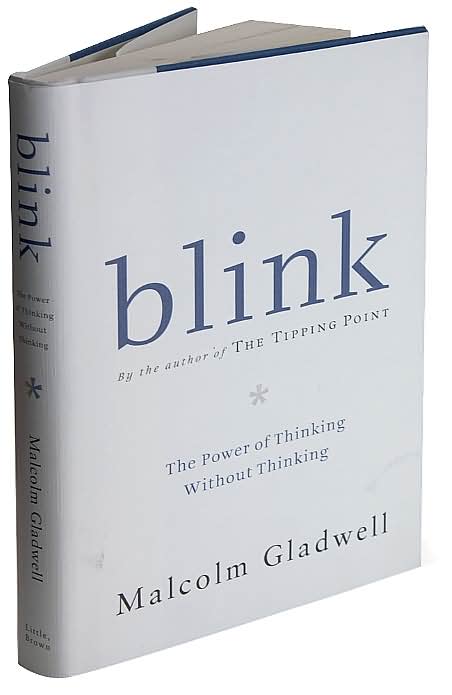
Paulo's Book Club: "Blink"

On my cruise I had time to read, finally. I read "Blink" by Malcolm Gladwelll and absolutely loved it. The book starts with a story about an ancient statue that a museum was considering buying for millions. All their research insisted that the statue was authentic. But several art specialists independently all had a bad feeling about it in the first two seconds after seeing it. Blink is about those two seconds. The statue was eventually shown to be a fake.
Blink is about how the mind's initial judgments are so powerful, and about the things that influence our decisions. How packaging for food makes people like the taste better. It also explains that autistics lack the skill of picking up on people's facial expressions. And how the cops who shot Diallo became momentarily autistic due to the pressure and missed all the cues in his face and body language that he was not a threat. My favorite chapter was about jusTON. It was called "The Warren Harding Error: Why we fall for tall, dark and handsome men." After reading that chapter I had a much better understanding of why everyone loves Justin.
The author, Malcolm Gladwell, also did a very interesting Curious Guy with Bill Simmons. He knows a lot about sports and uses his knowledge of the brain to analyze sports in an interesting way.

First recommendation in Paul's Book Club